

By Jennifer Schmidt dated July, 2024
What if the key to unlocking your potential lies in how well you manage your thoughts, emotions and actions, and not how ‘smart’ you are? Executive functioning and intelligence are two important concepts that shape our abilities and achievements.
In this article, we’ll review the science and history of both concepts. Then, we’ll review theories behind intelligence and myths about the relationship between intelligence and executive functioning. Let’s explore how these two concepts are related and how we can use what we know about the connection between the two to help improve everyday life.
The Science Behind Executive Functioning and Intelligence
Executive functioning is a set of cognitive skills that help us plan, organize, remember information, and make decisions. People with neurological or mental health conditions are more likely to have challenges with these skills, called executive dysfunction. This can make it harder to manage time, make decisions, pay attention, and control impulses, affecting everyday living. Executive functioning skills include attentional control, cognitive flexibility, emotional control, impulse control, organization, planning, problem solving, self-monitoring, task initiation, time management, and working memory.
Intelligence is the ability to learn from experiences and adapt to our surroundings. An Intelligence Quotient (IQ) is a score that measures a person’s intelligence using standardized tests. Scientists have debated whether intelligence is a single ability or a collection of mixed skills. Various theories reflect these differing beliefs, which are reviewed in a later section. Intelligence tests measure skills such as fluid reasoning, learned knowledge, visual-spatial, working memory, and processing speed, among many others.
A combination of genetic and environmental factors affects the development of EF and IQ. Differences in brain development associated with different genetic conditions can also contribute to the development of EF skills. There are no specific patterns linking diagnoses with corresponding EF and IQ skills.
Brief History of Intelligence and Executive Functioning Research on intelligence started in the late 1800s, while executive functioning was first defined in the 1970s, almost a century later. Since executive functioning is a piece of cognitive functioning, there’s been interest on how this connects to intelligence. However, research on how these concepts overlap is still early in development. Broadly, executive functioning and intelligence are similar, as they are both types of cognition. Executive functioning manages our higher-level problem solving and task management, while intelligence is the capacity to learn information, apply it to new situations, and understand information quickly. Both concepts have considerable history yet, there’s still so much more to be learned.
Analogy of the “Air Traffic Control System”
In a previous article, executive functioning was compared to an “air traffic control system.” This system manages the arrivals and departures of many aircrafts on multiple runways. In this same analogy, intelligence may be compared to the engine of the airplane. An airplane may have a powerful engine, with plenty of potential to take off and successfully complete a journey. However, the plane won’t perform as well if there are frequent delays, miscommunication, or collisions with other planes. The control system may struggle to coordinate flights, manage schedules, or respond to unexpected events. Without proper guidance and coordination, the plane might remain grounded or even fly in the wrong direction.
Differences in brain anatomy and physiology are believed to be in part responsible for differences in intelligence and executive functioning. The prefrontal cortex is crucial in EF skills. In fact, executive functioning was first described in the famous study of Phineas Gage (1840), who had an injury to his prefrontal cortex from an accident involving an iron rod and demonstrated more difficulty with self-control and hyperactivity after healing. On the other hand, intelligence relies on the integrated functioning of various brain regions (e.g., prefrontal cortex, parietal lobes, and temporal lobes) and networks. Intelligence also depends on certain mechanisms to take place, like synaptic plasticity and myelination, which allow us to process and learn information quickly.
Synaptic plasticity is the brain’s ability to change and adapt by forming new connections. Myelination is the process of covering our nerve fibers with a coating (myelin) that helps signals move better and faster in the brain. In the previous analogy, synaptic plasticity would be how certain routes are well maintained, while others are less traveled. Routes that are traveled the most often are likely to be well-maintained and easily traveled. When routes are less traveled, they will not be maintained and may even be forgotten for a better quality route. Myelination would be the plane’s insulation to ensure the electrical system transmits information quickly. This process and structure work together to operate our executive functioning and intelligence.
Theoretical Frameworks on Intelligence
Before we explore what’s the same and different about EF and IQ, we should explore what intelligence is as a construct. Various theories are available on how intelligence is understood by researchers, with three described below.
- The Cattell-Horn-Carroll (CHC) theory breaks intelligence down into layers to better depict different areas of individual strengths or challenges. This theory combines two previous theories, which combine the ideas of three layers and differences in fluid intelligence and acquired knowledge. The first layer of this theory is “general intelligence” (or “g”), which represents overall cognitive ability. The second and third layers are the “broad” and “narrow” abilities. Broad abilities (for example, short-term memory & processing speed; 16 in total) are different types of cognitive skills that a person may have strengths or challenges in. Narrow abilities (for example, working memory & reading/writing speed; 80+) are even smaller skills within each broad category. Each ability is placed in a category, such as short-term memory or processing speed. This theory is currently the one most supported by research and used in the development of IQ tests.
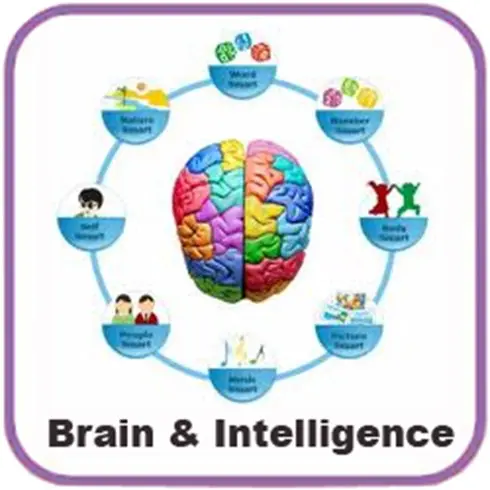
- Gardner’s Theory of Multiple Intelligences suggests that there are different ways in which a person can have cognitive strengths. He argues that there is no “general intelligence” or overall measure. There are eight distinct intelligences in this theory, including linguistic, logical-mathematical, spatial, musical, bodily-kinesthetic, interpersonal, intrapersonal, and naturalistic. This theory comes from the belief that intelligence comes in many forms, and people thrive in their own way. He wanted human intelligence to be recognized beyond linguistic and logical-mathematical skills in school settings.
- Sternberg’s Triarchic Theory of Intelligence suggests that there are three types of intelligence. This includes the ability to do well in different environments (practical), the ability to come up with new ideas (creative), and the ability to evaluate and solve new problems (analytical). He felt that it is important to know how effectively a person can problem solve real-life situations independent of formal tests. He believed intelligence is how well someone deals with environmental change across one’s life, and this skill can change over time.
Theoretical Frameworks on Executive Functioning
Research on executive functioning has questioned if EF was a single construct or if it was a collection of many skills that work together to manage our thinking and behavior. Most research on EF now acknowledges that EF is a collection of many skills. Areas where there is still debate include how many processes make up executive functioning and how independent these processes are.
- Miyake’s Three-factor Model suggested that there are three components of executive functioning. These include monitoring working memory, inhibiting responses, and shifting between tasks. It’s important to note that studies have been done that find different ways to think about EF. Most research on EF includes three components, they may just change the names to reflect the skills or organize the individual skills (such as organization, planning, and self-monitoring) in different ways.
- For example, the BRIEF-2 rating scale is created using the following three concepts, Behavior Regulation Index (e.g., Inhibit & Self-Monitor), Emotional Regulation Index (e.g., Shift & Emotional Control), and Cognitive Regulation Index (e.g., initiate, working memory, plan/organize, task-monitor). Other scales used to assess executive functioning contain similar skills, just presented and measured in slightly different ways.
Myths About the Relationship Between EF and IQ
Some misconceptions can emerge when learning about different ways to measure cognitive functioning. Three myths about the relationship between intelligence and executive functioning are addressed here to help differentiate between the two.
Myth 1: Executive functioning and intelligence are the same concept.
Many people mistakenly believe that intelligence and executive functioning are one and the same. When people have trouble staying on task, keeping organized, and managing emotions, it can be hard to demonstrate problem-solving skills. However, these concepts are related, not the same. For example, inhibition, an EF skill, allows the brain to acquire knowledge and execute other tasks, which are deemed “intelligent” skills. Without this skill, a person might be mistakenly thought to have trouble learning information rather than recognized as someone who struggles with inhibition, which is essential for the task at hand.
There are some similarities in both EF and IQ. Working memory is a skill included under the EF umbrella, and is evaluated as a part of many intelligence and executive functioning tests. Working memory is our ability to remember information and recall it later when we need it, as it allows an individual to hold information long enough in their mind to solve problems, which is required on IQ tests. From an EF perspective, working memory requires us to evaluate tasks, monitor performance, and adapt strategies to maintain cognitive control.
Myth 2: High Intelligence = Strong Executive Functioning or Low Intelligence = Weak Executive Functioning
A person’s intelligence does not determine their executive functioning skills and vice versa. These are different aspects of cognitive functioning. People with executive dysfunction may very well have the capacity to perform well, but their EF skills may get in the way of their ability to complete tasks. Often, people’s executive functioning challenges may be mistakenly judged on their intelligence because they struggle to organize and manage tasks and behavior. Similarly, individuals who excel in problem-solving at school or work, may still lack the EF skills to excel in school or work. In both cases, individuals are misunderstood as having or lacking skills that can be remediated.
Research has shown that IQ alone cannot predict a person’s executive functioning skills. It is important to note that conditions often overlap; meaning neurodivergent people often have two or more conditions that accompany one another. For example, people with intellectual disabilities are more likely to also have neurological, mental health or other physical conditions. We cannot determine what exactly causes executive dysfunction, but we can work on the skills that will help improve everyday functioning at school, work, or home.
Myth 3: Intelligence tests also measure executive functioning.
Tests of intelligence and executive functioning are common in clinical and school assessment plans. Since IQ and EF are separate concepts, their tests are also separate and cannot replace each other. There are various formal tests used to assess executive functions. These tests vary greatly in the ways that they assess EF, from direct tests (e.g., D-KEFS, NEPSY-II) to ratings completed by families, teachers, and by the person themselves (e.g., BRIEF-2, D-REF). Because most cognitive variables are at least moderately related with one another, the best ways to assess EF are still being explored.
There’s benefit to learning more about both areas of performance, in order to better understand neurodivergent individuals and their unique needs. Without information on both EF and IQ, we may miss crucial details about an individual’s needs.
Real-World Applications
Based on what we’ve covered, executive functioning and intelligence are separate but related concepts. It is important to know our strengths and challenges in both areas. It’s much easier to improve EF skills with targeted strategies and support. Intelligence is less adaptable with intervention, but strategies can be implemented to help people feel more successful. This is because our environment strongly impacts development and demonstration of both EF and intelligence when we are younger, with genetics becoming much more important in intelligence later in life.
Individuals with intellectual disabilities may experience unique challenges with problem-solving, executive functioning, and daily living skills. Individuals with intellectual disabilities are also more likely to have difficulties with EF skills, but the number and intensity of these challenges vary from person to person. This shows the importance of providing person-centered support and care, rather than a one-size-fits-all approach. Professional teams should learn about the individual by assessing intelligence, adaptive skills, and executive functioning skills.
Tools for assessing executive functioning and intelligence were referenced throughout this article. However, it’s important to note that assessments of intelligence can only be completed by licensed psychologists or school psychologists, due to the amount of training required. However, assessments of executive functioning are more accessible for individuals to explore their skills. If you’re looking for an easy to use self-help tool, the Executive Functioning Assessment can help you have a deeper understanding of your executive functioning strengths and challenges. Other EF specific tools are explained below.
Tools for Enhancing Executive Function
Let’s revisit the analogy from before, where our executive functions are the air traffic control system while the engine is intelligence. In this same scenario, professionals are the mechanics. A mechanic can pinpoint areas where the “air traffic control system” can be supported through regular maintenance and strategies to ensure optimal performance. EF skills can be improved to help neurodivergent people meet their goals.
TL;DR – (Too Long; Didn’t Read)
Executive functioning and intelligence are related but different concepts. Research on intelligence has a long history with many theories, while studies on executive functions followed almost 100 years later. Professionals still differ in how they define and measure these ideas. Both executive functioning and intelligence are cognitive concepts, just different types of skills. Executive functioning manages our higher-level problem solving and task management, while intelligence is the capacity to learn information, apply it to new situations, and understand information quickly.
An analogy can be used to help explain how executive functions and intelligence help control daily living skills. If we think of our bodies as airplanes, executive functions are the air traffic control system, and intelligence is the engine. Professionals can function as mechanics, helping to identify where improvements can be made to the system. Different brain processes such as synaptic pruning and myelination can help our airplane be quicker and more efficient.
People with differences in intelligence may also benefit from support with EF skills. However, challenges in one area (EF or IQ) do not automatically mean there will be challenges in the other area. Some individuals may need wrap-around support, while others might only need support with EF skills. This shows how person-centered support is important to identify all areas of need. Because EF skills can be improved to help people achieve their goals, neurodivergent individuals may find it helpful to work with a trained professional to help identify where support is needed.
Author: Jennifer Schmidt is a Wisconsin-based school psychologist. Jennifer earned her Master of Science in Education, with an emphasis in School Psychology, from the University of Wisconsin-Eau Claire. She also holds an undergraduate degree in Psychology, with a minor in Family, Health, and Disability studies from the University of Wisconsin-Whitewater. As an early career professional, Jennifer works in rural Wisconsin by partnering with teachers, school administrators, and other professionals to create safe, healthy, and supportive learning environments that strengthen connections between the school, home, and community agencies.